
Follow-up
One follow-up list beats three apps
Reminders in the phone, notes in chat and tasks in a board still miss people. One dated list next to the customer is enough for a small team.
9 min read
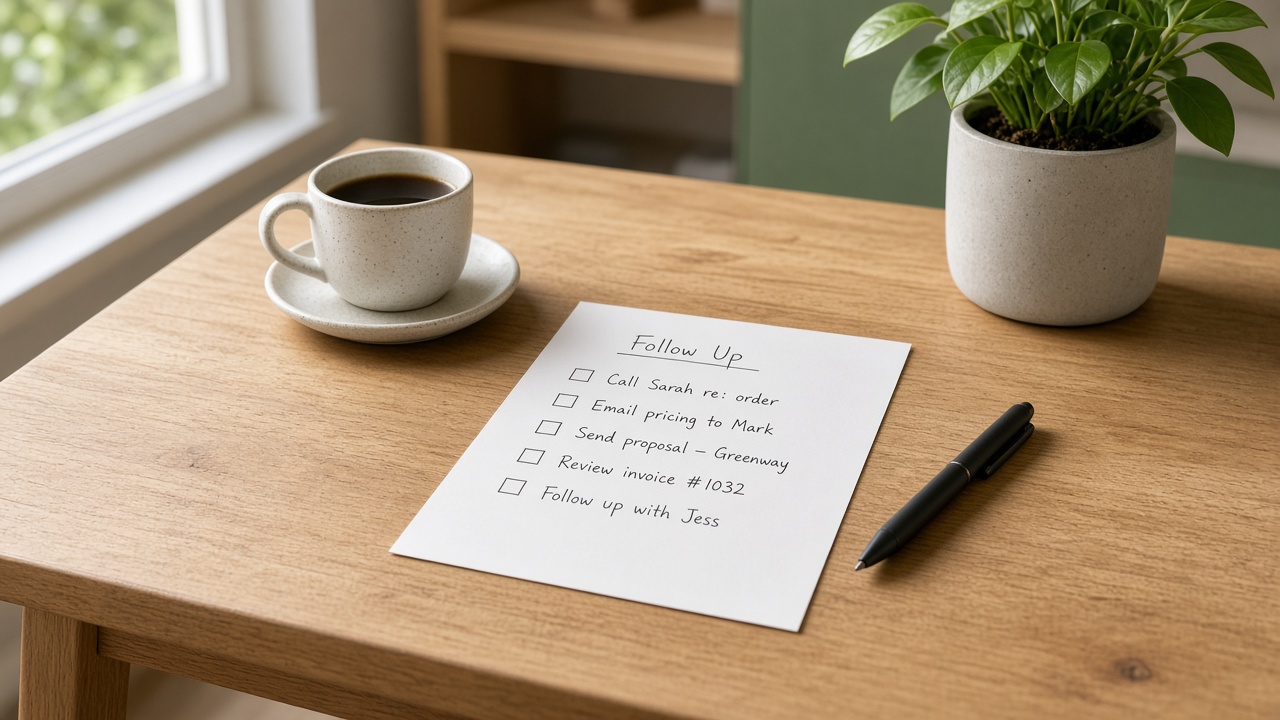
Teams often have a task app, a chat thread and a personal reminder. None of those know who the customer is. Follow-up then becomes a hunt: which quote, which number, who spoke last, and whether anyone already called this morning.
The cost is not only missed calls. It is thin conversations. You ring because a reminder fired, not because you can see the last note. The customer hears a check-in instead of a useful next step.
The hunt is expensive even when you eventually make the call. Ten minutes of reconstruction is ten minutes you did not spend on the next enquiry. Multiply that by a week and you have lost a morning.
A single dated list next to the customer sounds almost too small to be a system. That is why it works. Small teams do not fail because they lack software. They fail because the next step lives in too many places.
If you are still keeping a private backup 'just in case', the shared list is not trusted yet. Find the last miss and ask which field was missing. It is usually the reason or the date, not the app.
The cost of split reminders
You remember to call, but not which quote you sent. Or you see the task, but the last email is in someone else's mailbox. Or the chat says 'chase Smith' and there are three Smiths. The customer gets a vague check-in instead of a useful one.
Handovers fail the same way. The person covering the desk inherits a phone full of alarms that do not travel, and a Trello card with no address. They spend the morning reconstructing context instead of making the call.
- ✓Context lives in a different tool from the reminder
- ✓Handovers drop the next step
- ✓Nobody can see what is overdue across the team
- ✓The same person gets contacted twice, or not at all
Keep the next step on the record
A follow-up is a date, an owner and a reason. Call about the quote. Send the booking link. Check the job is done. That belongs on the contact or deal, not in a private list that vanishes when the phone is off.
If you cannot name the reason in a short phrase, you do not have a follow-up yet. 'Stay in touch' is a wish. 'Ring Tuesday about the kitchen quote' is work.
“I had reminders in three places and still missed the plumber who needed a yes by Friday. Once the next step sat on the customer, covering the office stopped being a briefing. You just opened the list.”
What the daily list should show
Once a day, open overdue and due today. That is the working set. Close what is done. Move what is waiting on the customer. Leave tomorrow's items alone unless you are ahead.
The list only stays honest if completing the call also completes the task. Teams that leave old ticks sitting on the page stop trusting the page, and then they go back to private reminders.
- ✓Overdue first, then due today
- ✓Owner visible so covering staff know who to ask
- ✓Reason visible so the call has a point
A week of follow-up without the hunt
Monday: three quotes sent last week, each with a Wednesday call. Tuesday: a booking to confirm for Thursday. Wednesday: the calls happen from the customer record, so the quote version is in front of you. Thursday: the visit goes ahead. Friday: two people who said 'next month' already have a dated check-in, not a mental note.
None of that requires a complicated workflow. It requires one place where the date and the customer cannot be separated.
Stop feeding the other lists
If the CRM list and the phone reminders both stay live, the phone will win on busy days because it buzzes. Then the CRM list goes stale, and you are back to three apps.
Pick a date to stop adding personal reminders for customer work. Existing alarms can be copied onto records in a single afternoon. After that, customer follow-up only lives next to the customer.
Review the list, not the noise
Chat is for exceptions. The follow-up list is for the work. If the team still asks in the group chat 'did anyone call the Johnson quote?', the list is not the source of truth yet.
That is the whole system: one dated list, reviewed daily, sitting on the people you already serve.
Why three tools feel safer and still fail
A phone reminder feels personal and reliable. Chat feels fast. A board feels official. Each one solves a discomfort. Together they create a new one: which list is true this morning?
People add a second list when they do not trust the first. Then they add a third when they miss something. The miss was usually a missing owner or a missing date, not a missing app.
Trust comes back when completing the work also completes the list. If ticking the task does not match what happened with the customer, people will keep a private backup. That backup is how you return to three lists.
Write the reason in a short phrase
The reason is what stops the call sounding empty. 'Ring about the kitchen quote sent Tuesday' gives you a conversation. 'Follow up Smith' gives you a pause and a guess.
If you cannot write the reason in one line, you do not know the next step yet. Sit with the record for another minute. Look at the last note. Then write the step. Do not save a blank reminder and hope future you will remember.
Good reasons are specific and near. Call about the quote. Send the booking link. Check the job is finished. Ask whether they want the second site priced. Vague staying-in-touch language is how lists fill with work nobody wants to open.
- ✓Who the customer is, on the record
- ✓What you will talk about, in one line
- ✓When, as a real date, not a mood
Covering the office without a briefing
Leave should not require a verbal tour of your brain. If the next steps sit on customers, the person covering opens overdue and due today. They see the quote, the last note, and the reason for the call.
If covering still needs a briefing, the list is incomplete. Usually the dates are there and the reasons are not, or the reasons are there and the files are somewhere else.
Try the leave test on a quiet afternoon. Hand the list to someone else for an hour. Watch where they get stuck. Those stuck points are the process, not the person.
A week run from one list
Monday: clear overdue first. Those are already late. Do not start with new and exciting work while old promises sit in the corner.
Midweek: add new follow-ups the same day you make the promise. Afternoon promises that wait for Friday admin are how Friday admin never happens.
Friday: look at next week. Move what is waiting on the customer. Close what is done. If the list is still honest on Friday, you will trust it on Monday. If it is stale, people will go back to phone alarms over the weekend.
What not to put on the list
Buying milk can stay on your phone. Internal chores that have no customer can stay on a personal list. Customer promises cannot. Mixing them is how the customer list becomes noisy and then ignored.
Recurring private rituals are fine in a personal app. 'Call the plumber who needs a yes by Friday' is not a private ritual. It is work the business owns.
Make completing the call complete the list
The list dies when ticks and reality diverge. If you called and left a voicemail, the task should say that and carry a new date. If you closed the job, the task should be done.
People keep phone alarms when they have been burned by a stale page. Earn the trust back with a week of honest ticks. Do not add a fourth app.
What overdue should mean
Overdue should mean a promise that slipped, not a museum of old wishes. If overdue is full of items nobody will ever do, clean it once. Then keep it clean.
A short overdue list gets worked. A long one gets ignored. That is true in every tool you have already tried.
When follow-ups sit next to the customer in Foxtra, anyone covering the desk can see what is due without asking around. The call is about the quote, the booking or the job, not a reconstruction of last week.
One list is a discipline, not a feature you turn on. You have it when overdue and due today is the first screen of the day, and when a completed call is a completed task.
Start tomorrow morning. Open one list. Work what is late. Write new next steps on the customer before you pick up the next job. Give it ten working days. The hunt gets quieter before the software feels exciting.
One list only works if it is true. True means dates, reasons, and ticks that match the week you are in.